“Guest Editorial by Ondrej Vysypal, August 2026 Electric Bike Magazine, electricbike.cz”
A DIFFERENT DIMENSION OF MANUFACTURING AT THE J&G TECHNOLOGY MEGA FACTORY
We visited a new factory that blends tradition with modernity and cutting-edge technology.
Just as the visit to Bafang was a smooth continuation of the previous two days spent at the China Cycle trade show, our next stop also has its own logical connection and continuity. And, as in any well-crafted drama, the plot of our Chinese journey now builds toward a truly stunning finale.
A NEW VENTURE
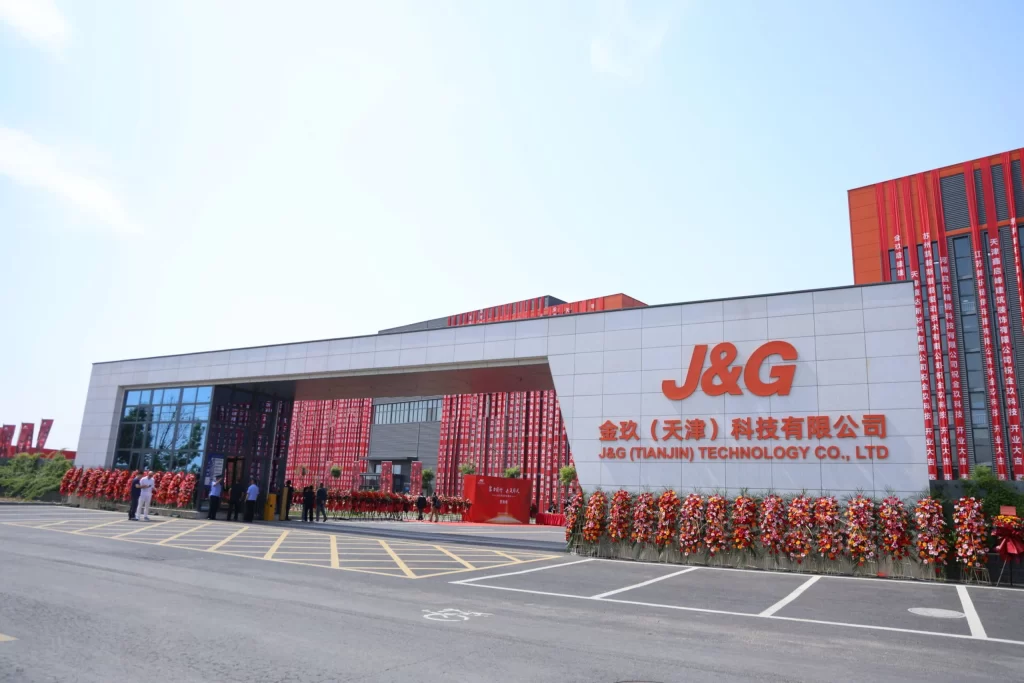
We’re in Tianjin, China’s third-largest city (14 million inhabitants), in an industrial zone in the northeast of the country, roughly a thousand kilometres from Shanghai. We flew in by plane, because a road trip would be something like a full-day expedition from home to Croatia — and we simply don’t have the stamina for that… This week, huge things are happening in China’s cycling business, with new beginnings and launches being announced in connection with the newly kicked-off five-year growth plan, and a grand celebration is also taking place here, in this important industrial city with its large, strategic port. China’s largest bicycle and e-bike manufacturer, Golden Wheel Group, together with its partner Joy Kie Corporation Ltd., is opening a joint venture and a new bicycle and e-bike factory named J&G Technology Co. It’s this modern production site and sprawling, multi-storey Mega Factory in the city’s industrial zone that we’ve been invited to see.
THIS COULD BE A MOVIE!
If this day full of contrasts and grand displays were to be turned into a film, I’d want it directed by Christopher Nolan or Denis Villeneuve. And alongside me, the screenplay could be written by Jules Verne, Franz Kafka, Karel Čapek, George Orwell, or Arthur C. Clarke. We step out of the taxi on the far side of a production hall the size of a decent logistics centre, and there isn’t a soul in sight. But as we walk around the building, we spot its other side, draped in wide red ceremonial ribbons with white and gold lettering, hanging all the way from the roof down to the ground. In front of the main entrance stands a grand setup. Massive barrier elements and floral arrangements line the area, ceremonial carpets are laid out, and rows upon rows of chairs are arranged theatre-style. Everything is in red and festive colours, complemented by portable flags, sound equipment, ribbons, balloons, and welcome banners.
A SHOW, OR A MILITARY PARADE?
As a journalist from Eastern Europe, such a backdrop inevitably evokes memories of military ceremonial parades or processions from the days of the Iron Curtain. In the present day, especially with the latest Xpeng P7 Ultra limousine and other electric vehicles casually parked in the nearby lot, it makes for a rather picturesque scene. That said, I don’t mean to downplay the seriousness of the occasion — especially since, just a few dozen metres later, the moment I step into the factory and glance into a few of the production halls, my jaw literally drops.
EVERYTHING UNDER ONE ROOF
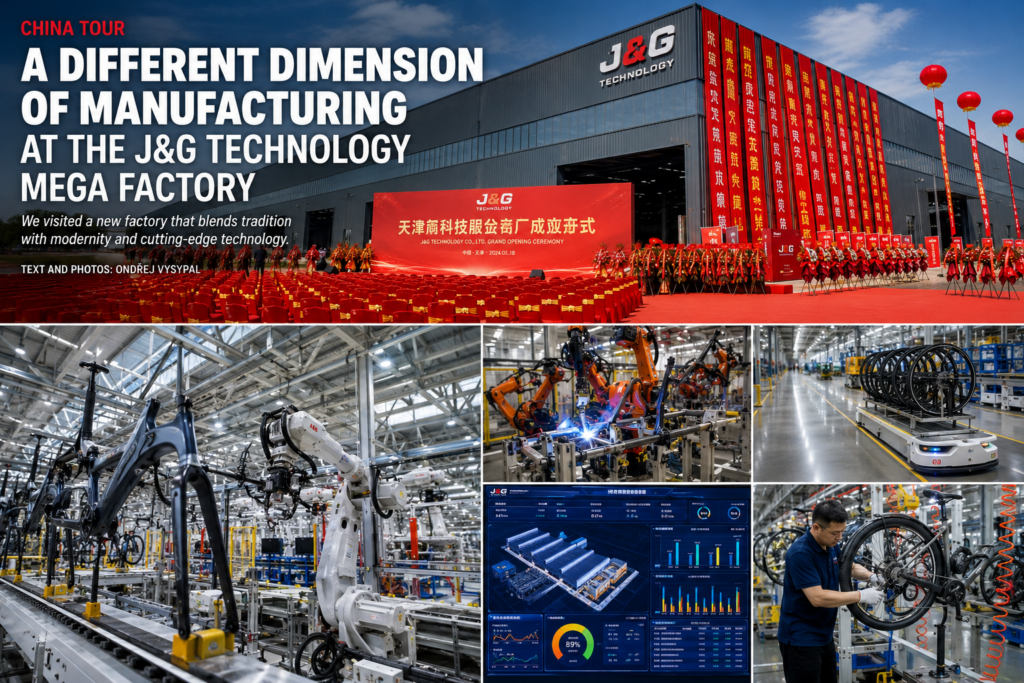
No, this really isn’t a standard factory where bicycles and e-bikes are simply assembled. This is an entirely different league of bicycle creation and completion. It’s a concentrated manufacturing, engineering, and assembly process, all under one roof. Every single operation — whether it’s automated frame production, carbon fibre weaving and preparation of carbon components, forks and frames for the moulds, robotic welding, painting, wheel-building, assembly and top-tier handling, testing, diagnostics — is something people have seen somewhere before. But at the new J&G factory, all of this unfolds, organised and orderly, on a “mere” 100,000 square metres, all under one roof! Employees work on specific tasks according to the classic and widely used Toyota TPS production management model, popular throughout China. Minimal waste and loss, maximum quality — these familiar values are here polished to perfection and combined with advanced ERP resource planning and operations management, maximum efficiency, thriftiness, and just-in-time delivery of prepared parts and components straight to the workstation. There, only the tools the worker needs at that exact moment are present. The skilled, quick hands of operators and workers exchange and pass tubes, struts, frames, wheels, and parts directly with robots and automatic feeders, and right before our eyes, frames and wheels take shape, carbon is baked, paint is applied, motors, forks, and components are installed, and so on. Every operation radiates careful thought, detailed planning, and efficiency. Individual products or entire pallets carry RFID identification, so the whole process can be tracked online in the company system, and production is relayed in real time to the screens of planners and control staff — everything is under absolute control.
SEEING THE UNSEEN
I’ve never actually seen e-bike production like this before. As we walk through the hall, automated guided vehicles and platforms move alongside us. Quiet, laser-guided electric carriers transport products and components around the production floor on their own, requiring neither a driver nor remote operation. AI-powered automatic inspections monitor the quality of production, work, and all activities in real time, while robotic pallet systems handle movement within the warehouse and the logistics that follow. Boxes of e-bikes are grasped by a powerful robotic arm. They turn in the air, then get stacked, wrapped in film and tape in batches of six, loaded, and driven off by themselves to the warehouse or for shipping. If this were the film I mentioned at the start, this would be the moment when the soundtrack swells, one character glances at the main protagonist, and quietly asks: “Have you ever seen anything like this in your life?” The hero just slowly shakes his head in silent amazement and murmurs: “No.”
CARBON PROCESSING
We saw workstations where carbon fabric is hand-laid for baking seatposts or handlebars, as well as laser cutting of precisely fitted pieces destined for the moulds. Laying up carbon and preparing components and frames is demanding work, still very much overseen by experienced, trained workers. There’s more than enough finishing and cleanup work throughout the entire process. We also had the chance to see the actual baking in the moulds, whether for forks or frames. Just the sheer number of the company’s own, original moulds lined up on shelves and racks is fascinating. They withstand the intense heat of the oven in the curing room. The carbon fabric bonds through heat and pressure and fuses with the impregnated resin, then transforms into a material that, in the finished bike, can carry a rider weighing a hundred kilograms, withstand torsion, tension, and compression, and absorb forces and vibrations. This is the manual, noisy, and dirtier part of the production process, compared to the other halls with their polished floors and surgically clean workbenches. The finished carbon frames and parts are then inspected — both visually and by hand — carefully cleaned, painted, and decaled… And of course, the paint shop itself couldn’t be missing here either! It operates at a high level, with an automated section and robotic spraying combined with piece-by-piece manual work, depending on the requirements and nature of the product.
MAN AND ROBOT
Welding aluminium frames is an interesting combination of manual work, semi-automated processes, and fully autonomous robotic performance. As already mentioned, the TPS production methodology here divides every line into individual stations, where a worker, a machine, or both together handle one set of tasks. For frame welding, the operator carefully places and aligns the parts into a fixture — or “jig,” if you will. Once everything is prepared, the jig is rotated, creating a protective shield, and the robotic arm takes over, quickly and precisely welding the tubes. It’s a remarkable interplay between human and machine. While the robot welds, a second worker prepares the next frame for joining, making the most of the time window during welding. As soon as the robot finishes one frame, it moves on to the next. And into the rotated jig, aluminium tubes are once again loaded by whichever worker’s turn it is. Two people feed the robot, keeping productivity at its maximum. Some lower-specification frames are welded by hand, but again, in perfectly prepared fixtures and with a clean finish.
A NEW ERA BEGINS
The visit to the new J&G Technology factory was a valuable and fascinating glimpse into the future, and at the same time a demonstration of how a carefully planned and tightly managed global bicycle and e-bike production operation actually works. This facility wasn’t built to churn out hundreds of thousands of units for storage and create thoughtless surpluses. On the contrary, it offers maximum flexibility and the ability to respond nimbly to conditions in any export market. Thanks to the Golden Wheel corporation and its brands Totem, Upland, and Amslod, the new factory can produce goods that perfectly meet European standards. At the same time, through business and distribution connections, the company has existing ties to brands such as 3T, Cinelli, Bianchi, Lapierre, Storck, and Pirelli, meaning that understanding Western thinking — and what customers in Europe and the US actually want — poses no difficulty whatsoever. What’s more, it’s located just a short distance from a key port and shipping routes to the entire world. Thank you for the opportunity to be part of it.
Guest Editorial by Ondrej Vysypal, August 2026 Electric Bike Magazine, electricbike.cz